


Child custody in Sacramento County, Placer County, or El Dorado County comes down to one central question: what arrangement is in your child’s best interest? When parents separate, that phrase can feel vague and even intimidating, especially when you are worried about how much time you will have with your children and who will make the important decisions in their lives. California law actually gives that standard real structure, and understanding it can help you approach your case with a clearer head and a stronger plan.
At Mason Law Office, we help parents across the greater Sacramento region understand how custody decisions are made, so you can protect your relationship with your children and move forward with confidence. This guide explains what the best interest standard actually means, how courts weigh the factors that shape a parenting plan, and the mistakes that most often hurt a parent’s position.
What the Best Interest Standard Actually Means
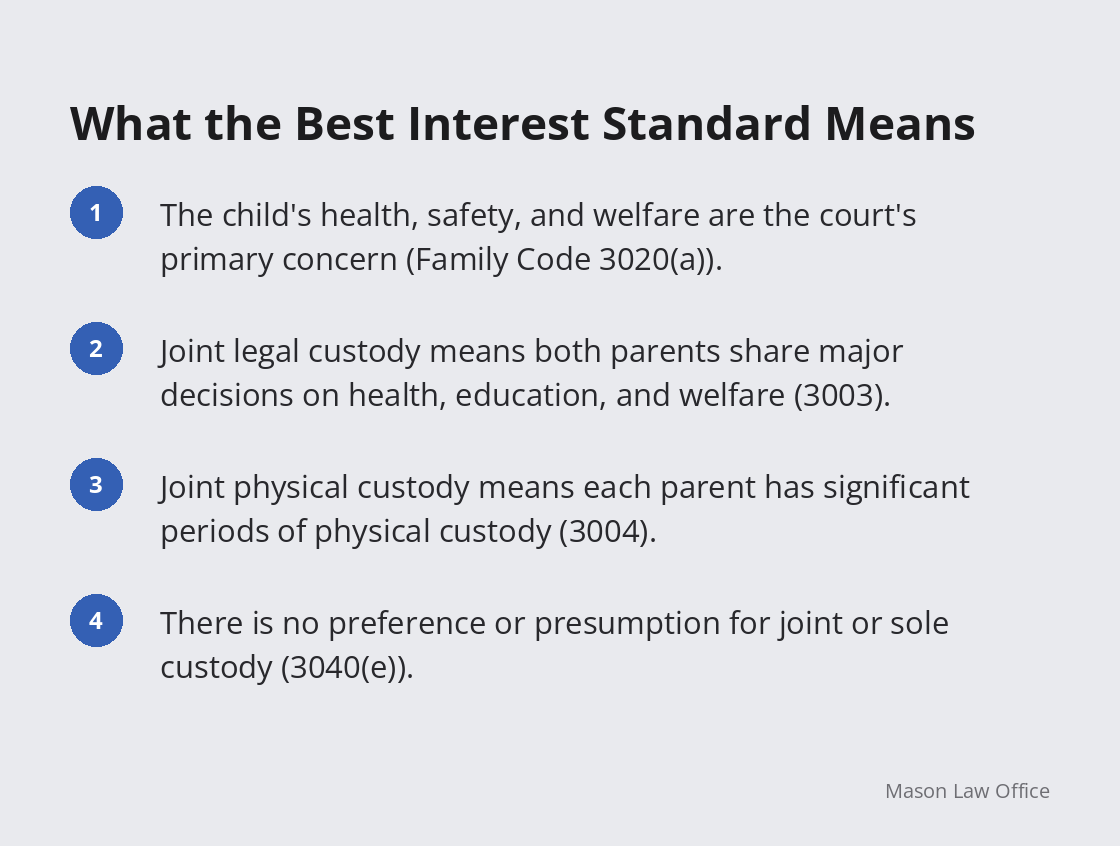
Every custody and visitation order in California is built around the best interest of the child. Family Code Section 3020 declares that the health, safety, and welfare of children shall be the court’s primary concern in determining the best interests of children when making orders about physical or legal custody or visitation. The same section declares that children have the right to be safe and free from abuse.
Before looking at how judges apply that standard, it helps to understand the vocabulary the Family Code uses. The words “legal custody” and “physical custody” mean different things, and a parenting plan can combine them in many ways.
Legal Custody and Physical Custody
Legal custody is about decision-making. Under Family Code Section 3003, joint legal custody means both parents share the right and the responsibility to make decisions relating to the health, education, and welfare of a child. Under Section 3006, sole legal custody means one parent has that right and responsibility.
Physical custody is about where the child lives. Section 3004 defines joint physical custody as each parent having significant periods of physical custody, shared in a way that assures the child frequent and continuing contact with both parents. Section 3007 defines sole physical custody as the child residing with and being under the supervision of one parent, subject to the court’s power to order visitation. Parents can share legal custody even when one parent has primary physical custody, so it is worth thinking about each piece separately.
Frequent and Continuing Contact With Both Parents
California also has a strong public policy favoring a child’s relationship with both parents. Family Code Section 3020(b) states that it is the policy of the state to ensure that children have frequent and continuing contact with both parents after the parents have separated, and to encourage parents to share the rights and responsibilities of child rearing, except when that contact would not be in the child’s best interest.
When the goal of frequent contact conflicts with the child’s health, safety, and welfare, Section 3020(c) directs that the court’s order be made in a way that ensures the health, safety, and welfare of the child and the safety of all family members. Safety comes first.
No Built-In Preference for Joint or Sole Custody
Many parents assume the law automatically favors a fifty-fifty schedule or automatically favors one parent. It does not. Family Code Section 3040(e) states that the section establishes neither a preference nor a presumption for or against joint legal custody, joint physical custody, or sole custody, and allows the court and the family the widest discretion to choose a parenting plan that is in the best interest of the child.
Section 3040 also makes clear that certain characteristics cannot be held against a parent. The immigration status of a parent does not disqualify that parent from receiving custody, and the court may not consider a parent’s sex, gender identity, gender expression, or sexual orientation in determining the best interest of the child.
How Courts Weigh Custody Factors in the Sacramento Region
Whether your case is filed in Sacramento County, Placer County, or El Dorado County, the same statewide Family Code factors guide the decision. Judges look at the specific facts of your family, but they do so through a framework the Legislature has spelled out in detail.
The factors below are not a checklist that produces an automatic result. They are the considerations a court must keep in view while it evaluates the evidence and the parenting plans each side proposes.
The Factors in Family Code Section 3011
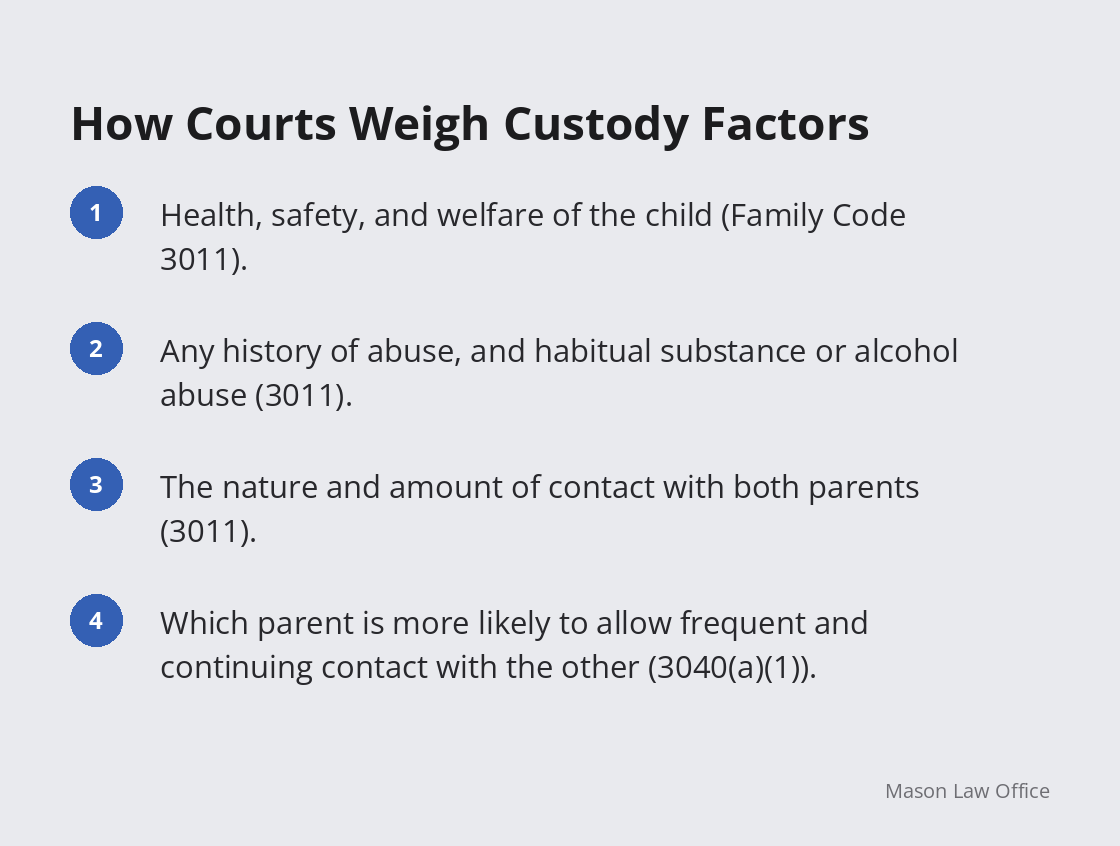
Family Code Section 3011 lists factors the court must consider, among any others it finds relevant. They include the health, safety, and welfare of the child; any history of abuse by a parent or other person seeking custody against the child, the other parent, or certain other people; the nature and amount of contact with both parents; and the habitual or continual illegal use of controlled substances or habitual or continual abuse of alcohol or prescribed controlled substances by either parent.
For allegations of abuse or substance misuse, the statute allows the court to require independent corroboration first, such as written reports from law enforcement or other public agencies. When those allegations have been raised and the court still grants custody or unsupervised visitation to that parent, Section 3011 requires the court to state its reasons in writing or on the record.
Which Parent Supports the Child’s Relationship With the Other
Family Code Section 3040(a)(1) provides that, in making an order granting custody to either parent, the court shall consider, among other factors, which parent is more likely to allow the child frequent and continuing contact with the noncustodial parent. The court may also require the parents to submit a plan for carrying out the custody order.
In practical terms, a parent who encourages the child’s bond with the other parent, follows the existing schedule, and communicates respectfully about the child’s needs tends to show the court exactly the kind of co-parenting California law values.
When a Child’s Preference Matters
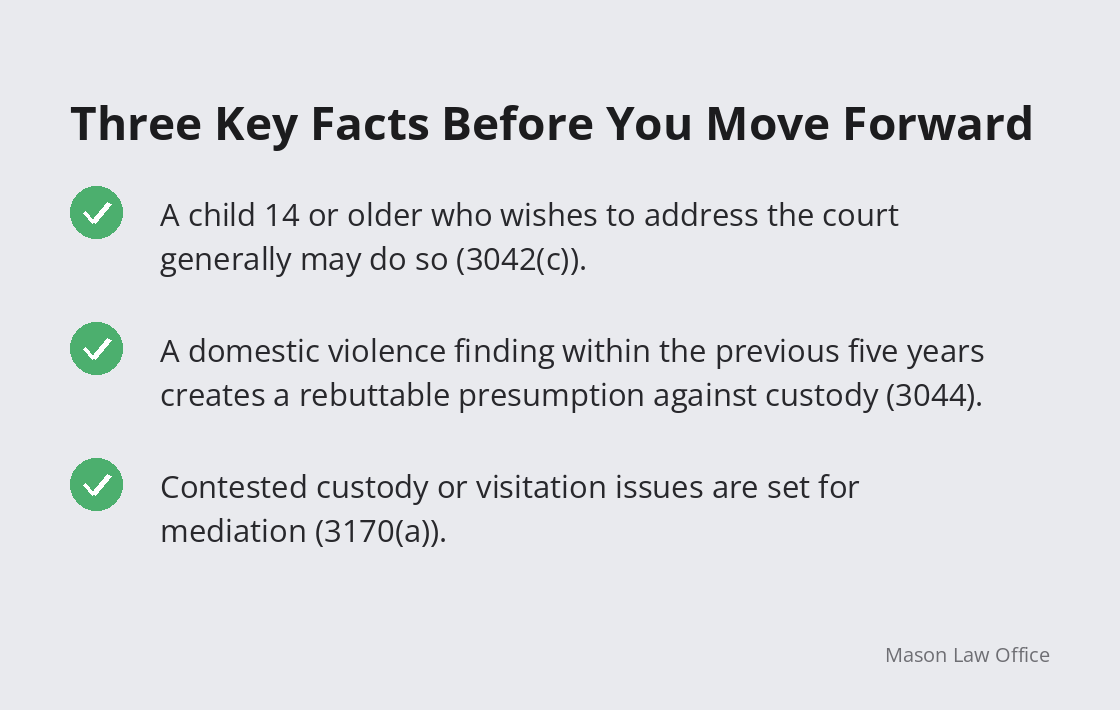
Children do have a voice in this process. Under Family Code Section 3042(a), if a child is of sufficient age and capacity to reason so as to form an intelligent preference, the court shall consider and give due weight to the child’s wishes. If a child is 14 years of age or older and wishes to address the court about custody or visitation, Section 3042(c) provides that the child shall be permitted to do so unless the court determines that doing so is not in the child’s best interest and states its reasons on the record.
A younger child may also address the court if the judge finds that appropriate, and the statute generally requires the court to provide an alternative to having the child speak in front of the parents. Section 3042 also makes clear that a child is not required to express a preference at all, which protects children from being placed in the middle.
Common Custody Mistakes That Can Hurt Your Case
Custody cases are emotional, and even loving, capable parents can make choices in the heat of a separation that work against them. Because the court focuses on the child’s health, safety, welfare, and relationship with both parents, behavior that undermines those goals tends to stand out.
The mistakes below are among the most common, and each one can usually be avoided with planning and support.
Putting Your Child in the Middle
Asking a child to choose sides, sharing details of the dispute with them, or pressuring them about what to tell the judge can backfire. Section 3042 is designed to let a child’s genuine wishes be heard while protecting the child, and it states that a child is not required to express a preference. Coaching a child can undercut both the child’s well-being and the credibility of the parent doing it.
Keeping adult conflicts between the adults allows your child to focus on school, friends, and their relationship with both of you, which is exactly what the best interest standard is meant to protect.
Overlooking the Impact of Domestic Violence Findings
Family Code Section 3044 creates a rebuttable presumption that awarding sole or joint physical or legal custody to a party is detrimental to the child’s best interest when the court finds that the party has perpetrated domestic violence within the previous five years against the other party seeking custody, the child, the child’s siblings, or certain other people. The presumption may be rebutted only by a preponderance of the evidence, and the policy favoring frequent and continuing contact cannot be used to rebut it.
If domestic violence is part of your family’s history, whether you are seeking protection or responding to allegations, it is important to understand how Section 3044 may affect the case before any custody hearing or mediation takes place.
Going Into Mediation Unprepared
Under Family Code Section 3170(a), when a request for a custody or visitation order shows that custody or visitation is contested, the court shall set the contested issues for mediation. Parents who arrive without a clear proposed schedule, without thinking through school routines and transportation, or without focusing on the child’s needs often find the process harder than it has to be. Our guide to child custody mediation in Sacramento County, Placer County, and El Dorado County explains what to expect and how to prepare.
A thoughtful parenting plan that reflects the factors in Sections 3011, 3020, and 3040 gives you a strong starting point, whether you reach an agreement or need the court to decide.
Final Thoughts
California custody law centers on your child’s health, safety, and welfare, along with the value of a strong relationship with both parents. Knowing how legal and physical custody work, which factors courts weigh, and how a child’s own voice fits into the process can turn an overwhelming situation into one you can plan for.
The parents who fare best are usually the ones who stay focused on their children, keep conflict away from them, and bring a realistic, child-centered plan to the table. Those choices matter long after the court’s order is signed.
If you are facing a custody decision in Sacramento County, Placer County, or El Dorado County, contact Mason Law Office to speak with our team. We will listen to your concerns, explain your options clearly, and help you take the next step with confidence.