


Dividing property in a divorce in Sacramento County, Placer County, or El Dorado County is often the part of the case that worries people most. The family home, retirement accounts, vehicles, savings, and even a small business can all be on the table, and it is not always obvious what belongs to the marriage and what belongs to one spouse alone. California follows a community property system, and understanding how it works can take a lot of the fear and guesswork out of the process.
At Mason Law Office, we help spouses across the greater Sacramento region understand their rights and organize their finances during divorce, so you can move forward with confidence. This guide explains how California community property actually works, how property is identified and divided during a divorce, and the mistakes that most often lead to an unfair result.
How California Community Property Actually Works
California’s property rules start with a simple idea: what spouses build together during the marriage generally belongs to both of them. The details, however, depend on when and how each asset was acquired and on the records that trace it.
Before anything can be divided, each asset and debt has to be identified and characterized as community or separate property. That characterization drives nearly every later decision in the case.
What Counts as Community Property
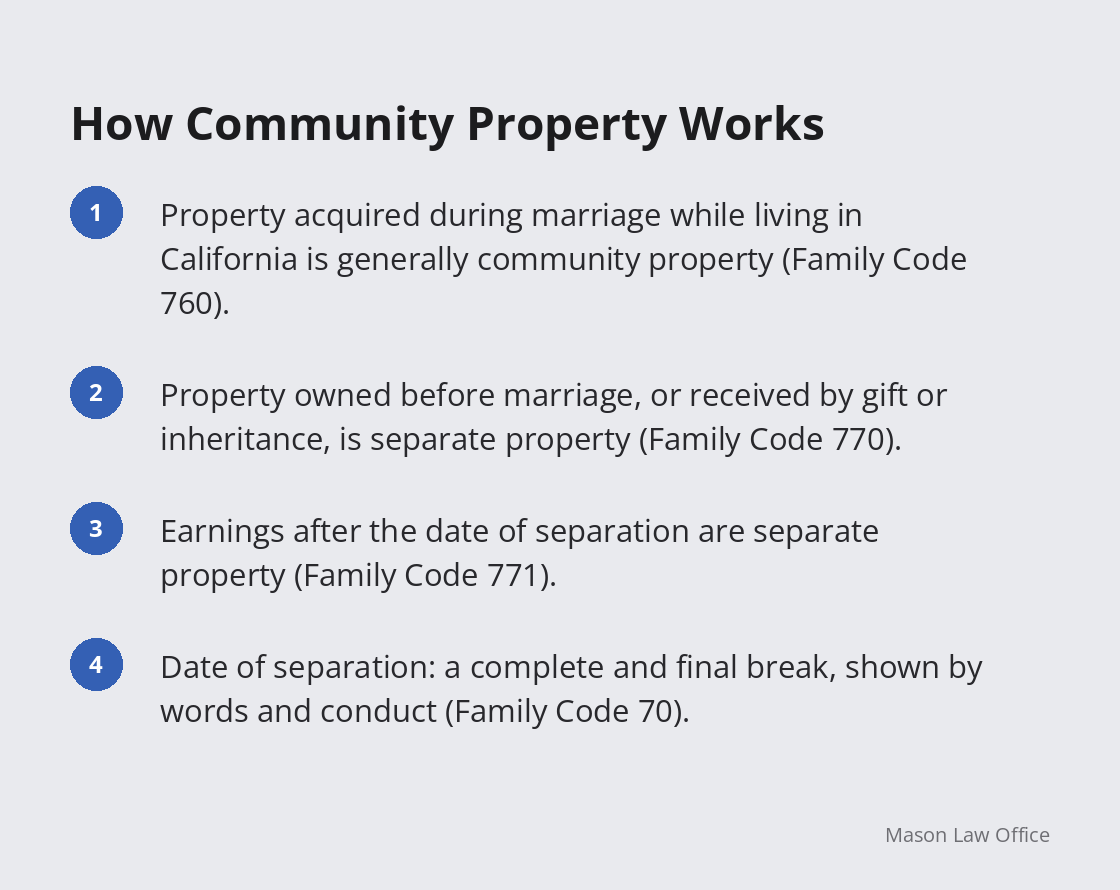
Family Code Section 760 provides that, except as otherwise provided by statute, all property, real or personal, wherever situated, acquired by a married person during the marriage while domiciled in California is community property. That includes wages earned during the marriage and the things purchased with those wages, no matter whose name appears on a paycheck or an account.
For many couples in Sacramento County, Placer County, and El Dorado County, this means a home bought during the marriage, savings built from earnings, and retirement contributions made during the marriage are all likely to be part of the community estate.
What Stays Separate Property
Not everything is shared. Family Code Section 770 provides that separate property includes all property a person owned before marriage, all property acquired after marriage by gift, bequest, devise, or descent, and the rents, issues, and profits of that separate property. An inheritance from a parent or a gift made only to you will usually remain yours.
Family Code Section 771 adds that the earnings and accumulations of a spouse after the date of separation are that spouse’s separate property. This is one reason the date of separation can matter so much in a California divorce.
Why the Date of Separation Matters
Family Code Section 70 defines the date of separation as the date a complete and final break in the marital relationship occurred, as evidenced by both a spouse expressing to the other the intent to end the marriage and conduct consistent with that intent. The court considers all relevant evidence when deciding that date.
Because earnings after separation are generally separate property, the date chosen can affect how bonuses, savings, and new purchases are treated. Text messages, moving dates, and changes in shared finances may all become evidence on this question.
How Property Is Divided in a Sacramento Area Divorce
Once property is identified and characterized, the court and the parties move toward dividing the community estate. Spouses can reach their own agreement, and many do, but the law sets the default rules that guide every negotiation.
Understanding those default rules helps you recognize whether a proposed settlement is fair before you agree to it. It also helps you focus negotiations on the assets that matter most to you, whether that is keeping the family home for your children, protecting retirement savings, or simply reaching a clean break that lets both spouses move on.
The Equal Division Rule
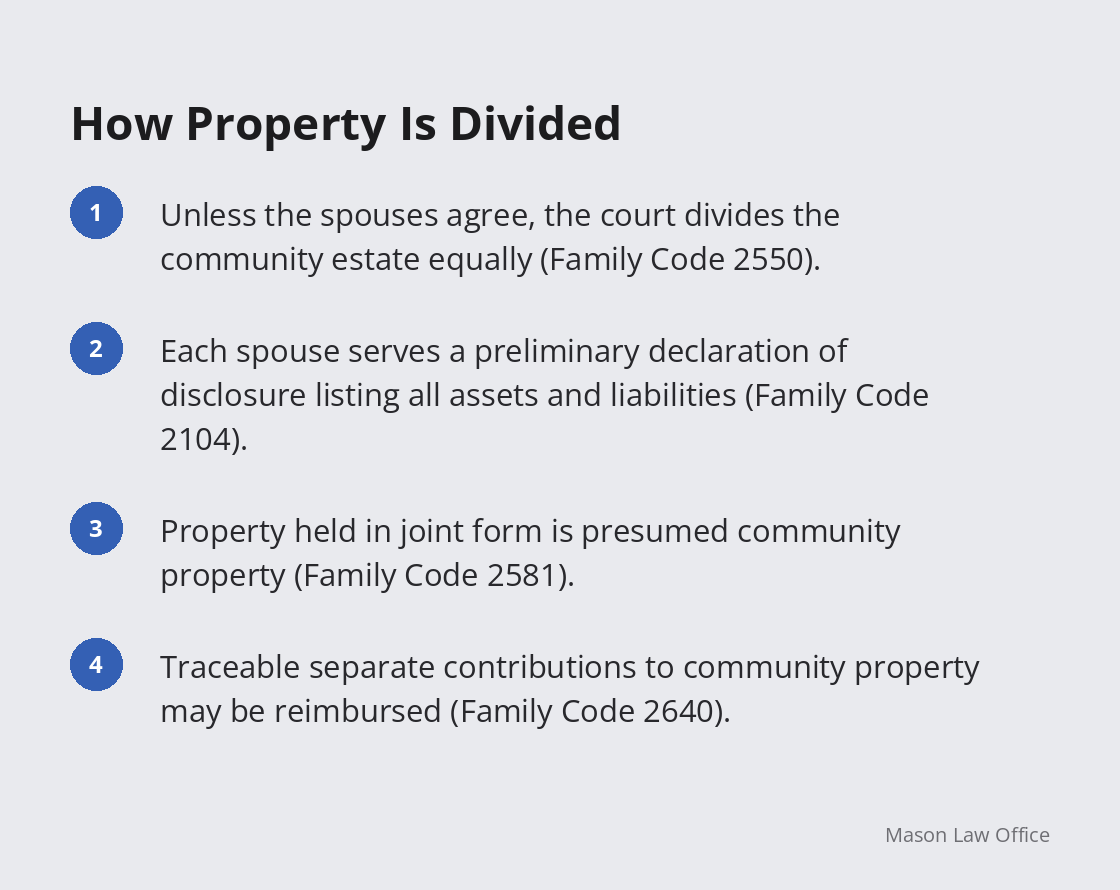
Family Code Section 2550 provides that, except upon the written agreement of the parties, an oral stipulation in open court, or as otherwise provided by law, the court in a divorce or legal separation shall divide the community estate of the parties equally. Equal does not always mean that each spouse receives half of every item. Often one spouse keeps the house while the other keeps retirement accounts or other assets of comparable value.
If you are still deciding between ending the marriage and staying legally married, our guide on legal separation vs. divorce explains how those paths differ.
Financial Disclosures Come First
California requires full financial transparency in divorce. Under Family Code Section 2104, each party must serve the other with a preliminary declaration of disclosure on a Judicial Council form, signed under oath, identifying all assets in which the declarant has or may have an interest and all liabilities for which the declarant is or may be liable, whether community or separate. The petitioner must serve it with the petition or within 60 days of filing, and the respondent with the response or within 60 days of filing the response, unless the parties agree in writing or the court extends the time.
These disclosures give both spouses the same starting information. Incomplete or inaccurate disclosures can create serious problems later, and the statute warns that false statements on the preliminary declaration may be grounds for setting aside the judgment.
Jointly Titled Property
Family Code Section 2581 provides that property acquired during marriage in joint form, such as joint tenancy, tenancy in common, or as community property, is presumed to be community property for purposes of division. That presumption can be rebutted by a clear statement in the deed or other title document that the property is separate, or by proof of a written agreement that the property is separate.
This rule often surprises spouses who used separate funds to help buy a jointly titled home, which leads to the next important concept.
Reimbursement for Separate Contributions
Family Code Section 2640 allows a spouse to be reimbursed for separate property contributions to the acquisition of community property, such as a down payment or payments that reduce loan principal, to the extent the contributions can be traced to a separate property source, unless that right was waived in writing. The statute limits that reimbursement and does not include interest.
Tracing usually requires old bank statements, closing documents, and account records, so gathering them early can make a meaningful difference.
Mistakes That Can Lead to an Unfair Property Division
Property disputes are often won or lost on preparation. A few common missteps can leave a spouse without rights they did not realize they had.
Avoiding these mistakes is far easier than trying to fix them after a judgment is entered.
Assuming the Name on the Account Controls
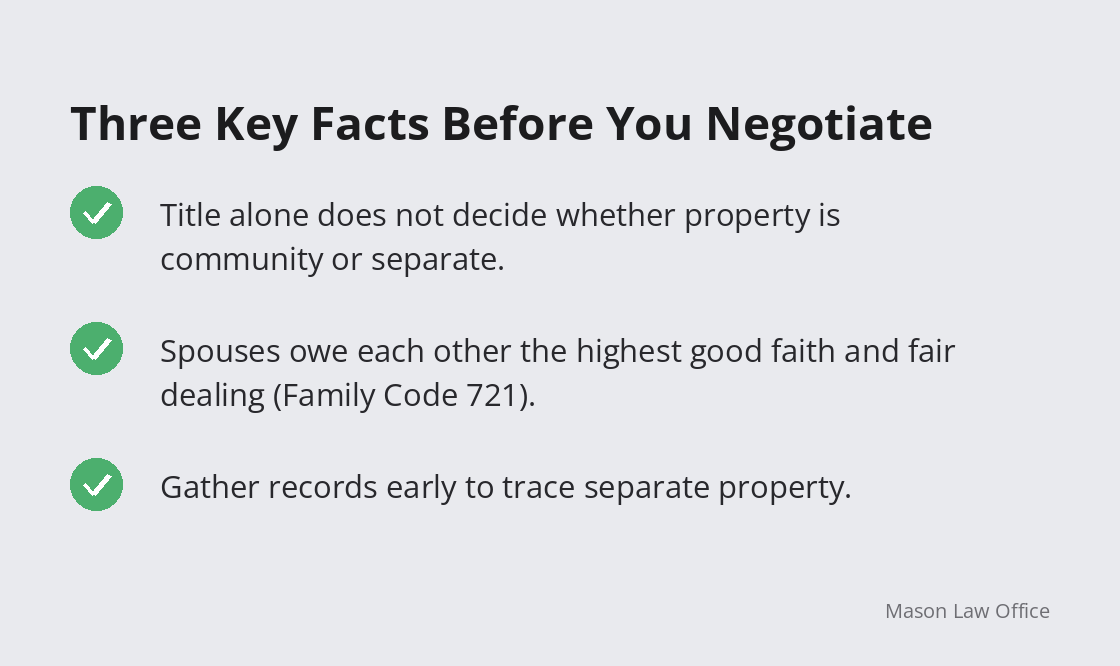
Many people believe that an account or vehicle in their own name belongs only to them. Under Family Code Section 760, the question is generally when and how the property was acquired, not whose name is on it. Earnings deposited during the marriage into an individual account are often still community property.
Making decisions based on title alone can lead to unpleasant surprises once the disclosures are exchanged. The same caution applies to debts. A credit card or loan in one spouse’s name may still need to be addressed as part of the overall division, so it helps to list every obligation alongside every asset before you begin negotiating.
Hiding or Mishandling Assets
Family Code Section 721 provides that spouses are in a fiduciary relationship, which imposes a duty of the highest good faith and fair dealing, and neither spouse may take unfair advantage of the other. That duty includes giving the other spouse access to records and true and full information about transactions concerning community property.
Moving money, transferring assets to relatives, or leaving accounts off a disclosure can damage your credibility with the court and lead to serious consequences in the case.
Failing to Trace Separate Property
Separate property claims depend on proof. If you brought savings into the marriage, received an inheritance, or used gift funds toward a home, you will usually need records that show where the money came from and where it went. Without tracing, separate property can blend into the community estate and be divided equally.
Start collecting statements and documents as soon as divorce becomes a possibility. Older records can be harder to obtain as time passes, and financial institutions do not always keep them indefinitely. A simple folder or spreadsheet that lists each account, the date it was opened, and where the money came from can save a great deal of time and stress later in the case.
Final Thoughts
Dividing property in a divorce in Sacramento County, Placer County, or El Dorado County follows clear California rules, but applying them to your own home, accounts, and debts takes careful work. Knowing what counts as community and separate property, how the date of separation and disclosures affect the outcome, and how to trace your contributions puts you in a far stronger position.
You do not have to sort through these questions alone. A thoughtful plan for gathering records and evaluating settlement options can protect what you have worked for and help you start the next chapter on solid ground.
If you are facing a divorce and want to understand how your property may be divided, contact Mason Law Office to speak with our team. We will review your situation, explain your options clearly, and help you take the next step with confidence.