


Child custody mediation in Sacramento County, Placer County, and El Dorado County is a required step for most parents who cannot agree on a parenting plan. If you have filed a request to set or change custody or visitation and the other parent disagrees, the court will send you to meet with a mediator before a judge decides the issue. For many parents, that appointment is the first time they sit across from the other parent to talk about the children since the separation, and knowing what to expect can make a real difference in how it goes.
At Mason Law Office, we help parents across Sacramento County, Placer County, and El Dorado County prepare for custody mediation and the court hearings that follow, so you can move forward with confidence. This guide explains what custody mediation actually is under California law, how the process works on the day of your appointment, and the mistakes that most often lead to an outcome parents did not want.
What Child Custody Mediation Actually Is in California
Custody mediation is built into the California Family Code. It is not a private negotiation you can simply skip, and it is not the same as a trial. Understanding the legal framework helps you see why the court places so much weight on this step.
When Mediation Is Required
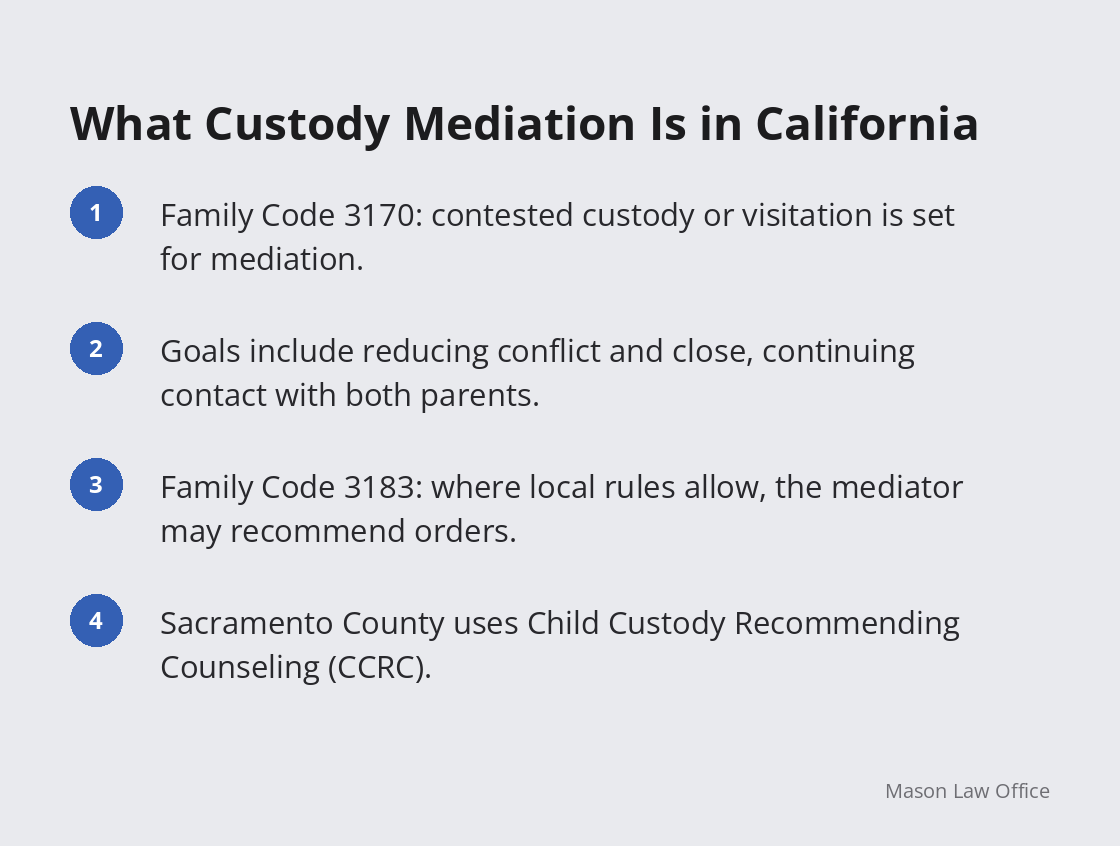
Family Code Section 3170(a) provides that if it appears on the face of a petition, application, or other pleading to obtain or modify a temporary or permanent custody or visitation order that custody, visitation, or both are contested, the court shall set the contested issues for mediation. That means mediation usually happens early, often before the first hearing on your request for orders. It can apply in a divorce, a legal separation, or a parentage case whenever custody or visitation is in dispute.
The Goals of Mediation Under the Law
The Family Code spells out what mediation is supposed to accomplish. Under Section 3161, the purposes of mediation are to reduce acrimony between the parties, to develop an agreement assuring the child close and continuing contact with both parents that is in the best interest of the child, and to settle visitation issues in a way that serves the child’s best interest. Section 3180 adds that the mediator has a duty to assess the needs and interests of the child and may interview the child when the mediator considers it appropriate or necessary.
Recommending and Confidential Models
Not every county runs mediation the same way. Family Code Section 3183 allows the mediator, consistent with local court rules, to submit a recommendation to the court about custody or visitation, as long as the parties and their attorneys receive the recommendation in writing before the hearing. When mediators can make recommendations, the process is called child custody recommending counseling. The Judicial Council of California explains that courts use confidential, recommending, or mixed models, and that parents should contact their local superior court to learn which model applies.
How Sacramento County Handles Custody Mediation
The Sacramento County Superior Court uses Child Custody Recommending Counseling, often called CCRC, when custody or visitation is in dispute. According to the court, if parents reach only a partial agreement or no agreement, the mediator will make recommendations to the court on the items still in dispute. The court also lists tasks parents must complete before the appointment, including submitting a parenting plan questionnaire and completing the Family Court Services orientation program. If your case is in Placer County or El Dorado County, check that court’s Family Court Services procedures, because steps and requirements can differ from county to county.
How the Custody Mediation Process Works
Most parents feel more comfortable once they understand the sequence of events. While details vary by court, the basic path from filing to a custody order follows a predictable pattern.
Preparing for Your Appointment
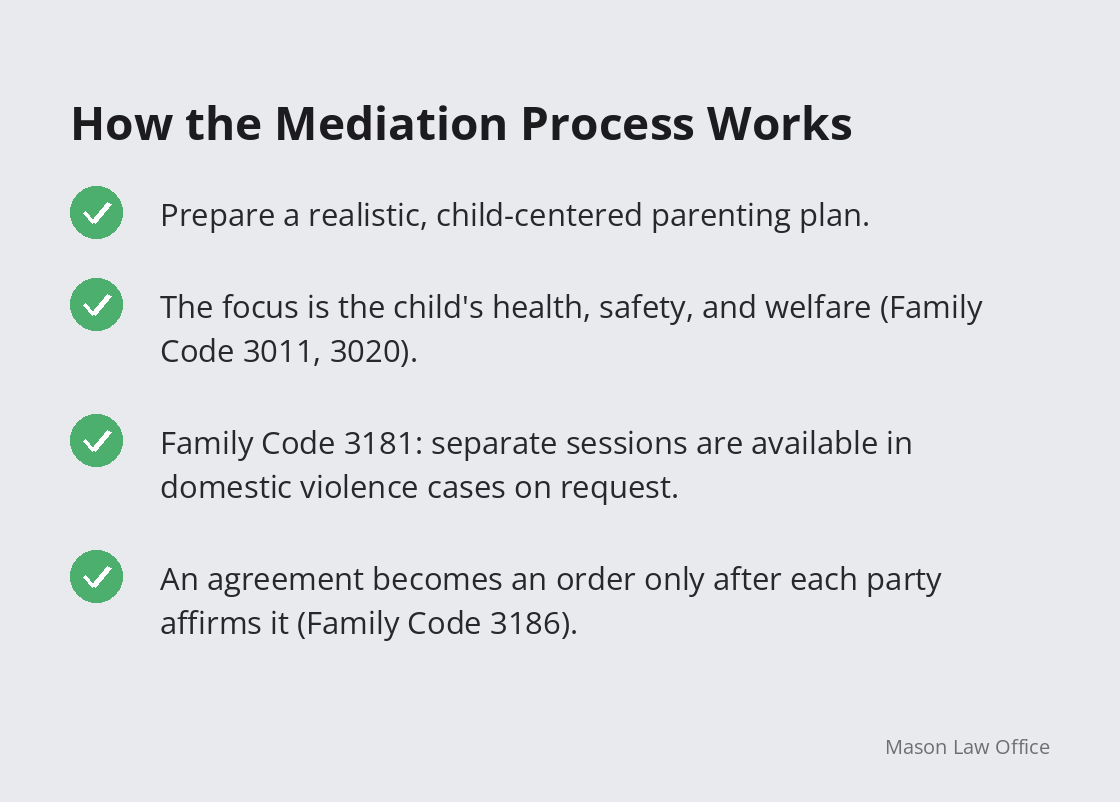
Preparation starts well before you meet the mediator. Think carefully about a realistic schedule for school days, weekends, holidays, and vacations, as well as how exchanges will happen and how you will communicate with the other parent. Gather information about your child’s school, activities, health care, and daily routines. Parents who arrive with a thoughtful, child-centered proposal are usually better able to negotiate than those who come only with complaints about the other parent.
What Happens During Mediation
The mediator will usually meet with both parents to discuss the issues in dispute and explore possible solutions. The focus stays on the child’s best interests, which Family Code Section 3011 says include the health, safety, and welfare of the child, any history of abuse, the nature and amount of contact with both parents, and habitual or continual substance abuse by either parent. Section 3020 adds that the state’s policy is to ensure frequent and continuing contact with both parents when that contact is in the child’s best interest, while the child’s health, safety, and welfare remain the court’s primary concern.
Safety Protections When There Is Domestic Violence
Mediation includes protections for parents who have experienced abuse. Under Family Code Section 3181(a), where there has been a history of domestic violence between the parties or a protective order is in effect, the mediator shall meet with the parties separately and at separate times at the request of the party alleging domestic violence in a written declaration under penalty of perjury or the party protected by the order. Family Code Section 3170(b) also requires domestic violence cases to be handled by Family Court Services under a separate written protocol approved by the Judicial Council.
What Happens After Mediation
If parents reach an agreement, Family Code Section 3186(a) requires the mediator to report it to counsel for the parties before it is reported to the court. Under Section 3186(b), an agreement may not be confirmed or incorporated into an order unless each party has affirmed and assented to it in open court or by written stipulation. When parents do not agree, the mediator may, under Section 3183(b), recommend that an investigation be conducted or that other services be offered before a hearing. In a recommending county, the judge will also have the mediator’s recommendations when deciding the disputed issues.
Custody questions often arise alongside other issues in a divorce. Our guide to legal separation vs. divorce in Sacramento County, Placer County, and El Dorado County explains how parenting orders fit into each path.
Mistakes That Can Hurt Your Custody Mediation
Many parents lose ground in mediation not because of the facts of their case but because of how they approach the process. Avoiding a few common mistakes keeps the focus where the law puts it, on your child.
Treating Mediation Like a Courtroom Battle
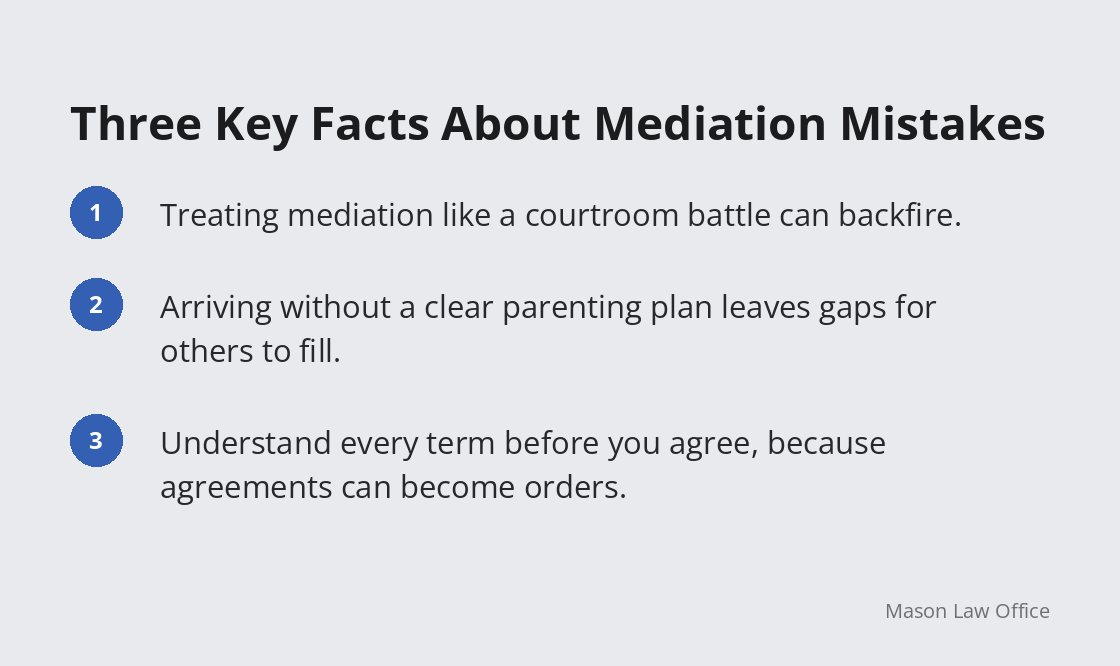
Mediation is designed to reduce conflict, and mediators pay close attention to how each parent communicates. Parents who spend the session criticizing the other parent, refusing to consider compromise, or focusing on adult grievances often come across as less focused on the child. Calmly explaining your concerns and offering practical solutions shows that you can cooperate in raising your child, which is exactly what the law encourages.
Arriving Without a Clear Parenting Plan
Coming to mediation without a concrete proposal leaves the other parent or the mediator to fill in the details. A clear plan that covers regular schedules, holidays, transportation, decision-making, and communication gives the discussion structure. It also helps the mediator understand what you believe will work best for your child, which matters if the mediator later makes recommendations to the court.
Agreeing to Terms You Do Not Understand
The pressure of the appointment can lead some parents to accept terms they have not fully thought through. Because an agreement can become a court order once each party affirms and assents to it as Section 3186 describes, it is important to understand every term before you agree. Ask questions, take notes, and consider speaking with a family law attorney before you sign or stipulate, especially if the agreement changes where your child lives most of the time or how major decisions are made.
Final Thoughts
Child custody mediation in Sacramento County, Placer County, and El Dorado County gives parents a meaningful chance to shape their own parenting plan before a judge steps in. California law requires mediation when custody or visitation is contested, focuses the process on the child’s health, safety, and welfare, and builds in protections for families affected by domestic violence. Parents who prepare carefully and stay focused on their child are in the best position to reach a workable agreement or to present their concerns clearly if the mediator makes recommendations.
Every family is different, and the right parenting plan depends on your child’s age, needs, routines, and relationships. Thoughtful preparation and a clear understanding of how your county’s process works can turn a stressful appointment into a productive step forward.
If you have a custody mediation coming up or are considering a request to change custody or visitation, contact Mason Law Office to speak with our team serving Sacramento County, Placer County, and El Dorado County. We will help you prepare, explain how California’s rules apply to your family, and help you move forward with confidence.