


A prenuptial agreement in Sacramento County, Placer County, or El Dorado County gives you and your future spouse a chance to make clear, thoughtful decisions about property and finances before the wedding, rather than leaving those questions to a court years later. Yet a prenup only protects you if it holds up when someone tries to enforce it. California has specific rules about how these agreements must be written, signed, and timed, and small shortcuts can undo an otherwise careful plan.
At Mason Law Office, we help couples across the greater Sacramento region create premarital agreements that reflect their goals and meet California’s requirements, so you can move forward with confidence into your marriage. This guide explains what a prenup actually does under California law, how the signing process should work, and the mistakes that most often lead to a challenge.
What a Prenuptial Agreement Actually Does in California
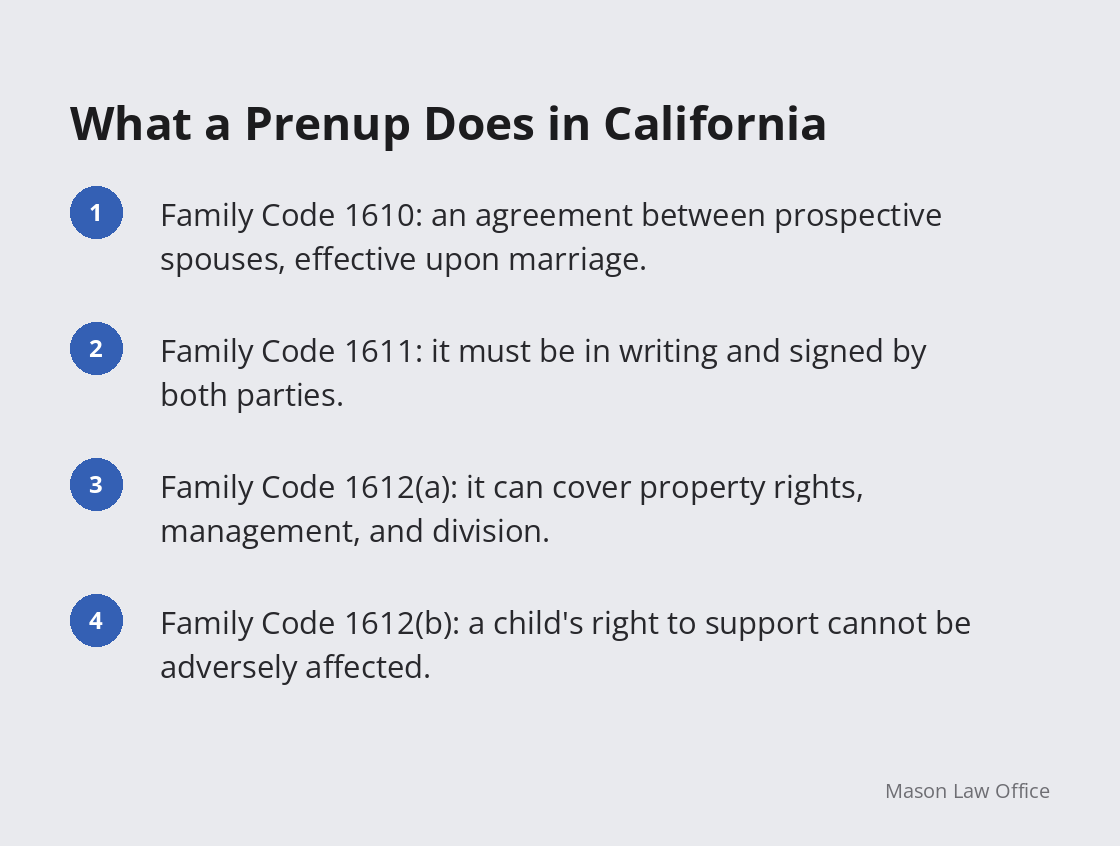
California adopted the Uniform Premarital Agreement Act, which appears in Family Code sections 1600 through 1617. Under Family Code 1610, a premarital agreement is an agreement between prospective spouses made in contemplation of marriage and meant to take effect upon marriage. The same section defines property broadly, covering present or future interests, legal or equitable interests, and both real and personal property, including income and earnings. Family Code 1613 confirms that the agreement becomes effective only once the marriage takes place.
Because California is a community property state, many couples use a prenup to decide in advance how assets and earnings acquired during the marriage will be treated. Without an agreement, the default rules of the Family Code apply. With a valid agreement, couples can tailor those rules to their own circumstances, whether one partner owns a business, expects an inheritance, has children from a prior relationship, or simply wants clarity about who owns what.
What You Can Include
Family Code 1612(a) lists the subjects a premarital agreement may cover. These include each spouse’s rights in property of either or both of them whenever and wherever acquired, the right to buy, sell, manage, and control property, and how property will be divided upon separation, dissolution, death, or another event. Couples may also agree to make a will or trust to carry out the agreement, set ownership of life insurance death benefits, and choose which state’s law governs how the agreement is interpreted. The statute also allows any other matter, including personal rights and obligations, that does not violate public policy or a criminal statute.
What a Prenup Cannot Do
Some limits cannot be bargained away. Family Code 1612(b) states that the right of a child to support may not be adversely affected by a premarital agreement. That means parents cannot use a prenup to reduce or waive support for their children, because the right to support belongs to the child and is decided by the court under California’s support laws when the need arises. Agreements that attempt to override public policy in other ways also risk being disregarded by the court.
Spousal Support Provisions
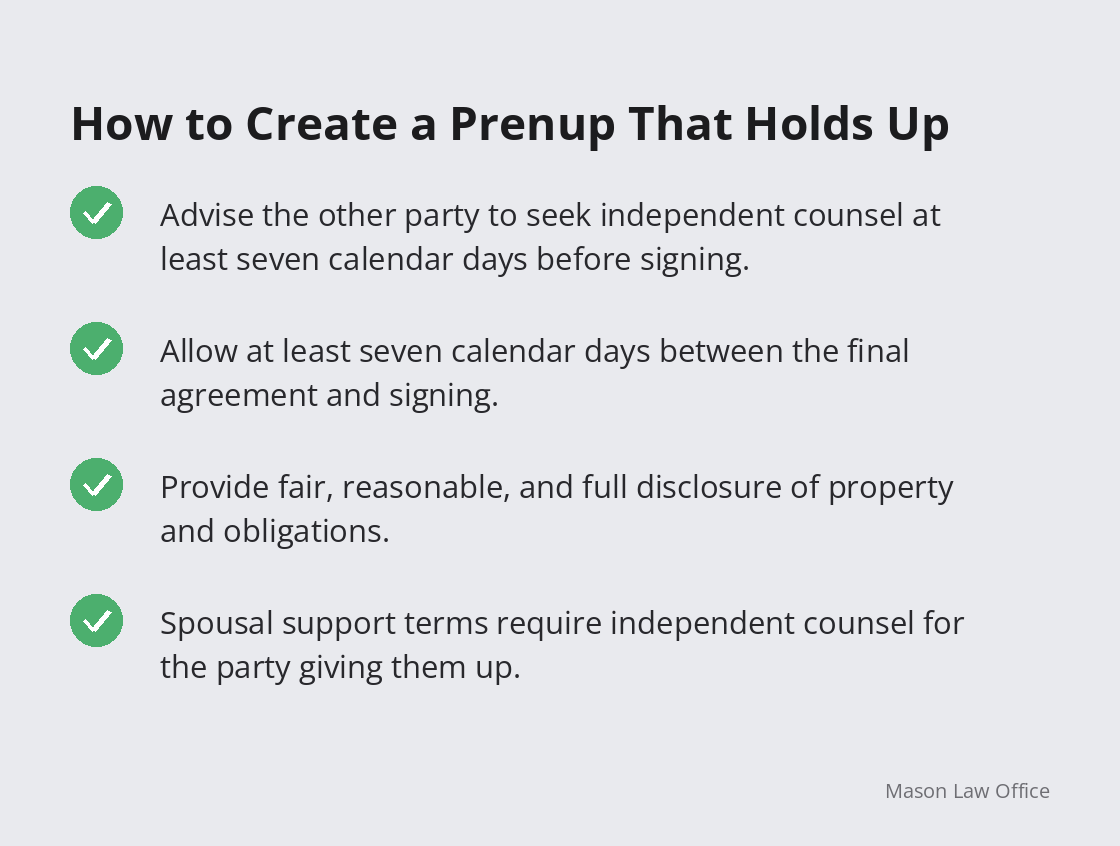
Spousal support receives special treatment. Under Family Code 1612(c), any provision regarding spousal support, including a waiver, is not enforceable if the party against whom enforcement is sought was not represented by independent counsel when the agreement was signed. A spousal support provision is also unenforceable if it is unconscionable at the time of enforcement, which means a court looks at the situation when the marriage ends, not just when the agreement was signed. Our guide to spousal support in Sacramento County, Placer County, and El Dorado County explains how courts approach support when no valid agreement controls.
How to Create a Prenup That Holds Up
The formal requirements for a California prenup are short, but they are strict. Family Code 1611 requires that a premarital agreement be in writing and signed by both parties, and it is enforceable without consideration. Beyond those basics, the enforceability rules in Family Code 1615 focus heavily on whether each person signed voluntarily, had time to reflect, and understood what they were giving up. Building the process around those rules from the start is the best way to protect the agreement later.
Independent Counsel and the Seven-Day Rule
Under Family Code 1615(c), a court will deem an agreement involuntary unless it finds, in writing or on the record, several conditions. One is that the party against whom enforcement is sought was represented by independent legal counsel at signing or, after being advised to seek independent counsel, expressly waived representation in a separate writing. The advisement to seek counsel must be made at least seven calendar days before the final agreement is signed. For agreements signed on or after January 1, 2020, that party must also have had at least seven calendar days between first being presented with the final agreement and signing it, regardless of whether they had a lawyer.
Full and Fair Financial Disclosure
Disclosure is central to enforceability. Family Code 1615(a)(2) explains that an agreement may be set aside if it was unconscionable when signed and, before signing, the challenging party was not given a fair, reasonable, and full disclosure of the other party’s property or financial obligations, did not voluntarily and expressly waive further disclosure in writing, and did not have, and reasonably could not have had, adequate knowledge of those obligations. Sharing complete information about assets, debts, and income, and attaching it to the agreement, is the simplest way to remove this argument.
Protections When One Party Has No Lawyer
If one person chooses not to hire a lawyer, Family Code 1615(c)(3) adds more safeguards. The unrepresented party must be fully informed of the terms and basic effect of the agreement and the rights and obligations being given up, and must be proficient in the language used for that explanation and for the agreement itself. The explanation must be written and delivered before signing, and the unrepresented party must sign a document declaring they received the information and identifying who provided it. Section 1615(c)(4) also requires that the agreement was not signed under duress, fraud, or undue influence and that neither party lacked capacity.
Common Mistakes That Put a Prenup at Risk
Most prenup disputes do not involve dramatic wrongdoing. Instead, they grow out of rushed timelines, incomplete paperwork, or assumptions that an agreement signed years ago will automatically be enforced as written. Understanding the most common mistakes helps couples in Sacramento, Placer, and El Dorado counties avoid them.
Waiting Until the Last Minute
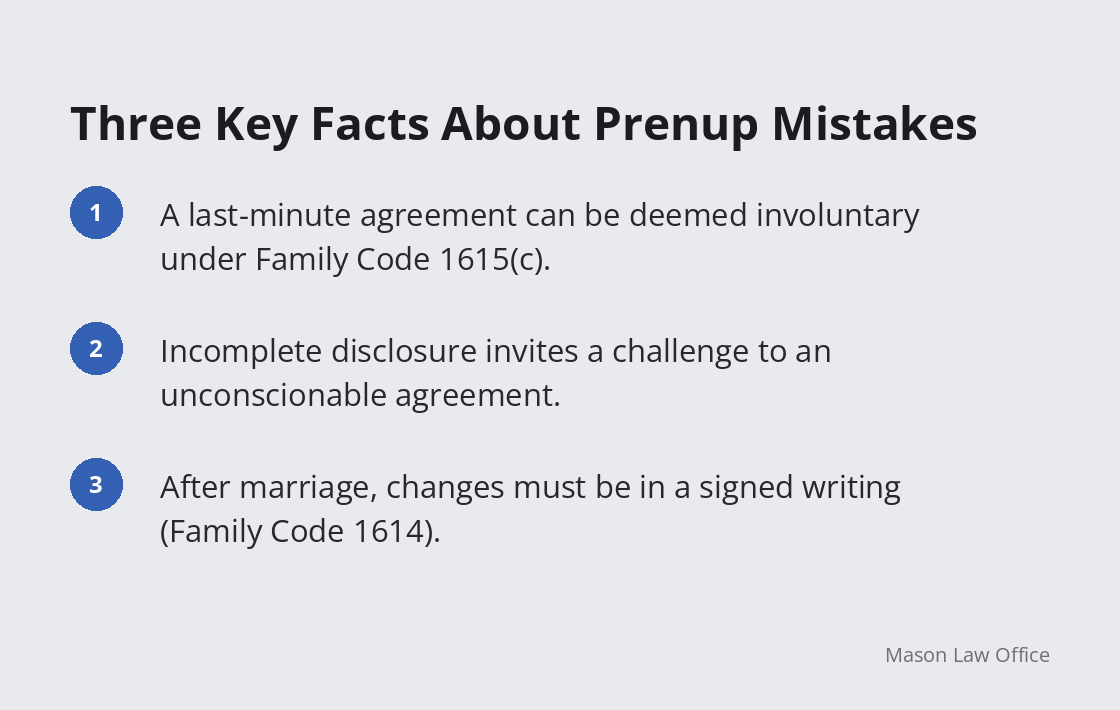
Presenting a final agreement days before the wedding is one of the most frequent errors. Because Family Code 1615(c) requires at least seven calendar days between receiving the final agreement and signing it, a last-minute document may be deemed involuntary. Even when the deadline is technically met, pressure from guests, vendors, and travel plans can fuel claims of duress. Starting the conversation months ahead gives both partners time to review drafts, ask questions, and consult their own counsel.
Incomplete Disclosure
Leaving out a retirement account, a business interest, or a significant debt may seem minor at the time, but it can become a central issue later. As explained above, a lack of fair, reasonable, and full disclosure is one of the conditions that can lead a court to refuse enforcement of an unconscionable agreement. Thorough schedules of assets and obligations, reviewed by both parties before signing, protect everyone involved.
Informal Changes After the Wedding
Couples sometimes agree verbally to ignore part of their prenup or assume their conduct during the marriage has changed it. Family Code 1614 states that after marriage, a premarital agreement may be amended or revoked only by a written agreement signed by the parties. Family Code 1617 also provides that statutes of limitations for claims under a premarital agreement are tolled during the marriage, although equitable defenses such as laches and estoppel remain available. Keeping any changes in a signed writing avoids confusion later, and our article on legal separation versus divorce explains how these issues arise when a marriage changes course.
Final Thoughts
A prenuptial agreement is a practical planning tool that lets you and your future spouse decide important questions together, while you are on the same team. California law gives couples wide freedom to shape their property rights, but it also protects each person through strict rules on writing, timing, disclosure, independent counsel, and voluntariness. Agreements that follow those rules are far more likely to be enforced as intended.
The strongest prenups are planned early, built on complete disclosure, and signed after each partner has had real time to review and seek advice. Whether you are just beginning to discuss a prenup or want an existing draft reviewed, careful attention now can prevent conflict and uncertainty later.
If you are planning a marriage in Sacramento County, Placer County, or El Dorado County, contact Mason Law Office to speak with our family law team. We will walk you through California’s requirements, help you prepare an agreement that reflects your goals, and help you move forward with confidence.