


Legal separation vs. divorce in Sacramento County, Placer County, and El Dorado County is a choice many spouses face once they know the marriage cannot continue as it is. Both paths lead to court orders about property, debts, support, and children, but they end in very different places, and the right choice depends on your goals, your timeline, and how long you have lived in California and in your county.
At Mason Law Office, we help spouses across Sacramento County, Placer County, and El Dorado County understand their options before they file, so you can move forward with confidence. This guide explains what a legal separation actually is under California law, how the process compares with a divorce, and the mistakes that commonly cause spouses to choose the wrong path or lose time along the way.
What Legal Separation Actually Means in California
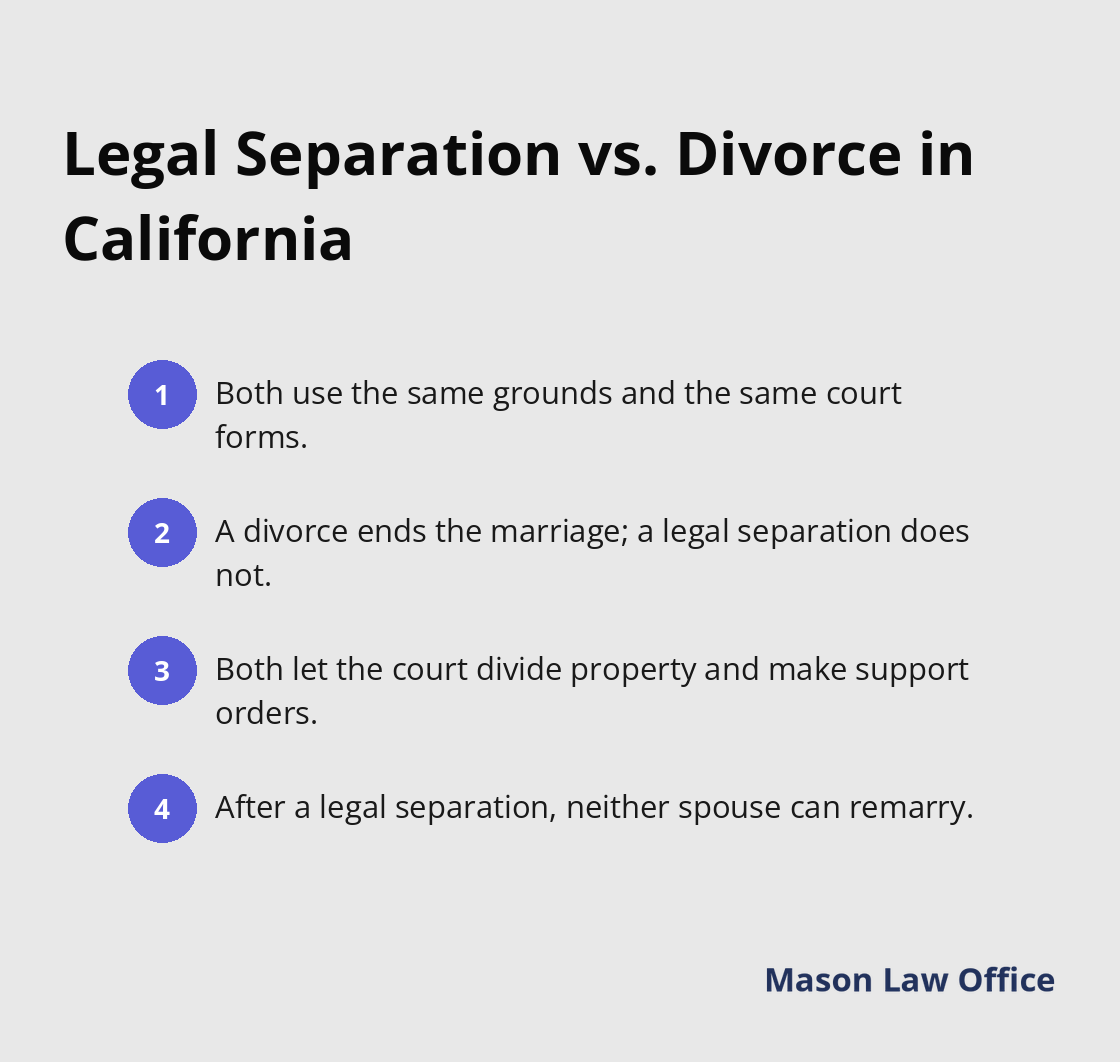
California treats divorce, which the Family Code calls dissolution of marriage, and legal separation as two closely related proceedings. Family Code Section 2310 provides that dissolution of the marriage or legal separation of the parties may be based on irreconcilable differences that have caused the irremediable breakdown of the marriage, or on permanent legal incapacity to make decisions. In other words, the reasons you give the court are the same whichever path you choose. The difference lies in what happens to the marriage itself when the case is over.
You Remain Legally Married
The California Courts self-help guide explains that in a legal separation, you stay married, but the court divides your property and debts and makes orders about financial support. That single fact drives most of the decision. Because the marriage continues, neither spouse can marry or enter into a domestic partnership with someone else after a legal separation. A divorce, by contrast, ends the marriage. Family Code Section 2300 provides that a final judgment of dissolution restores the parties to the state of unmarried persons.
The Court Can Make the Same Core Orders
Many people assume a legal separation is an informal arrangement, but it produces enforceable court orders. Family Code Section 2550 directs the court, in a proceeding for dissolution or for legal separation, to divide the community estate equally unless the spouses agree otherwise in writing or by oral stipulation in open court. Family Code Section 4330 allows the court to order spousal support in a judgment of dissolution or legal separation. The court can also make orders about child custody, parenting time, and child support in either type of case.
Why Some Couples Choose Separation Instead of Divorce
The California Courts self-help guide notes that some couples do not want to divorce for religious reasons, personal beliefs, or financial reasons, such as keeping a spouse on an insurance or benefit plan. Others are not yet sure the marriage is over and want clear orders while they decide. Still others choose legal separation because they do not yet meet the residency requirements for a divorce, which is one of the most important practical differences between the two proceedings.
How Legal Separation and Divorce Actually Differ in Sacramento County, Placer County, and El Dorado County
The steps to request a legal separation or a divorce are largely the same. According to the California Courts self-help guide, you use the same court forms and follow the same set of instructions, checking the boxes for legal separation instead of dissolution. Your case is filed in the superior court for your county, whether that is Sacramento, Placer, or El Dorado. The key differences come down to residency, timing, and consent.
Residency Requirements
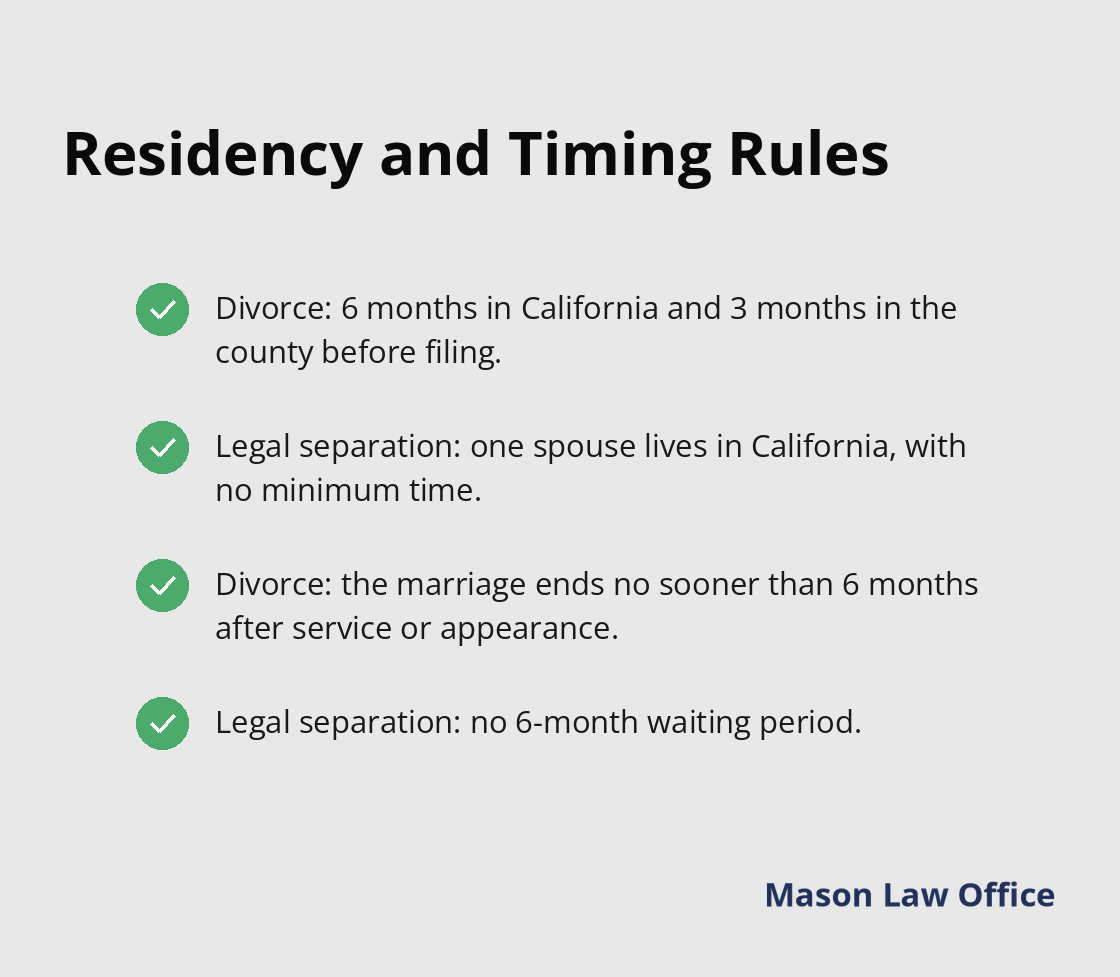
Family Code Section 2320 provides that a judgment of dissolution may not be entered unless one of the spouses has been a resident of California for six months and of the county where the case is filed for three months immediately before the petition is filed. A legal separation does not carry the same time requirement. The self-help guide explains that only one spouse must live in California to file for legal separation, and there is no minimum period. For spouses who recently moved to Roseville, Folsom, Placerville, or elsewhere in the region, that difference can matter a great deal.
Converting a Separation Into a Divorce
Family Code Section 2321 gives spouses a practical bridge. In a legal separation case where neither spouse met the residency requirements when the case began, either spouse may, once those requirements are met, amend the petition or response to request a judgment of dissolution. The date of the amended filing is treated as the start of the dissolution case for residency purposes only. The self-help guide adds that if your spouse files for legal separation but you want a divorce, you can respond by asking for a divorce.
The Six-Month Waiting Period
Family Code Section 2339 provides that a judgment of dissolution is not final for the purpose of ending the marriage until six months have passed from the date the respondent was served with the summons and petition or the date the respondent appeared in the case, whichever happens first, and the court may extend that period for good cause. The self-help guide confirms that there is no comparable six-month waiting period for a legal separation, although the issues in the case still have to be resolved by agreement or by the court before a judgment is entered.
Consent of Both Spouses
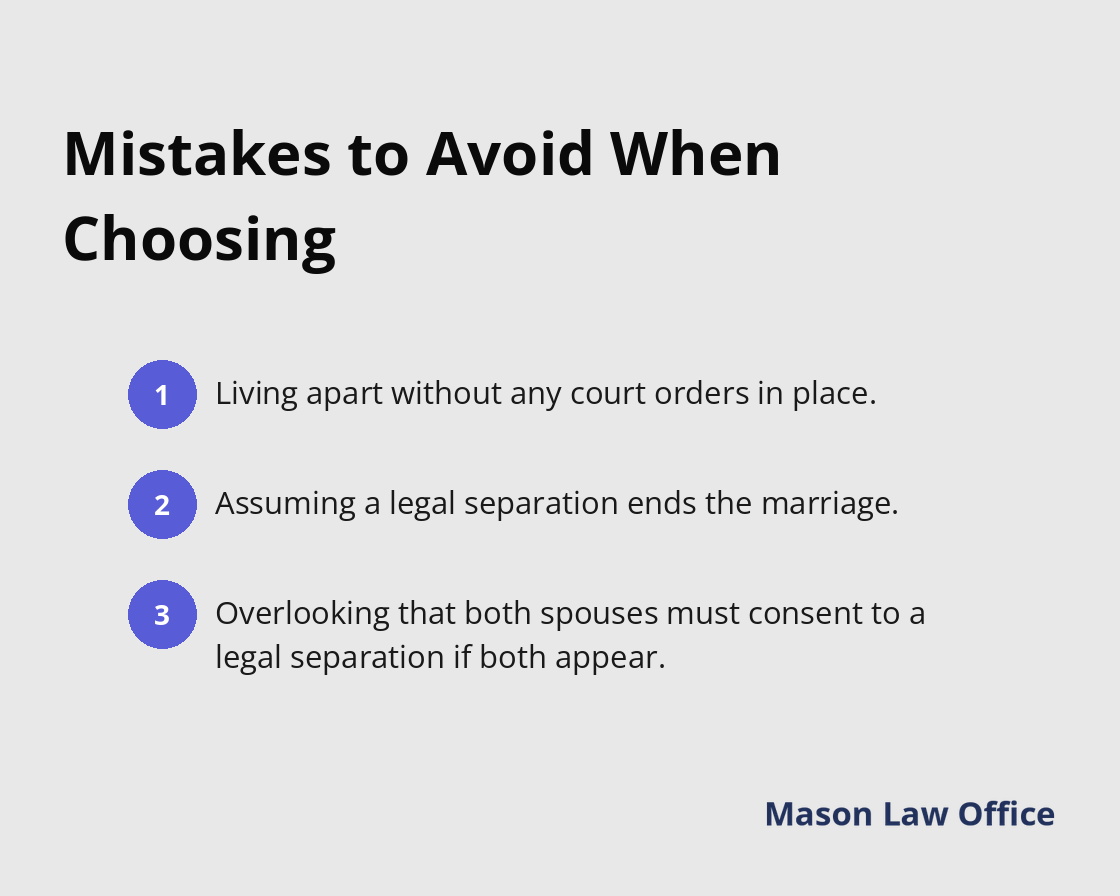
One difference surprises many people. Family Code Section 2345 states that the court may not render a judgment of legal separation without the consent of both parties, unless one party has not made a general appearance and the petition is one for legal separation. In practical terms, if your spouse participates in the case and asks for a divorce instead, the court generally cannot force a legal separation on an unwilling spouse. Section 2345 places this consent requirement only on judgments of legal separation, not on judgments of dissolution.
What Commonly Derails the Choice Between Separation and Divorce
Choosing between legal separation and divorce is not only a legal decision but also a personal one, and mistakes usually come from misunderstanding what each option does. A clear picture of the consequences before you file helps you avoid wasted time and repeated filings.
Treating Separation as a Trial Run Without Orders
Simply living apart is not the same as a legal separation. Without a court case, there are no enforceable orders about property, support, or parenting time. Spouses who move out without any orders sometimes find later that important questions about who pays which debts, who stays in the home, or how the children divide their time were never clearly resolved. A filed case, even one that ends in legal separation rather than divorce, gives both spouses a framework the court can enforce.
Assuming Legal Separation Ends the Marriage
Because a legal separation judgment divides property and sets support, some spouses later assume they are free to remarry. They are not. The marriage continues until a court enters a judgment of dissolution and that judgment becomes final. Anyone who expects to remarry, or who wants a complete legal end to the relationship, should understand from the start that a divorce, not a legal separation, is the path that accomplishes that goal.
Overlooking Your Spouse’s Position
Because of Section 2345, a petition for legal separation can turn into a divorce case if your spouse appears and does not consent. Spouses who file for legal separation for religious or personal reasons should think through how they would respond if the other spouse asks for a divorce instead. Planning for that possibility, and understanding how property division, spousal support, and custody orders apply in either type of case, keeps the process from feeling like it has slipped out of your control.
Final Thoughts
Legal separation and divorce in California share the same grounds, the same forms, and many of the same court orders. The biggest differences are that a legal separation leaves you married, does not carry the six-month and three-month residency requirements for divorce, has no six-month waiting period to end the marriage, and generally requires the consent of both spouses if both take part in the case. If support is a central issue for you, our guide to spousal support in Sacramento County, Placer County, and El Dorado County explains how California courts approach that question in both types of cases.
There is no single right answer for every family. The best choice is the one that fits your goals, your beliefs, your timeline, and your children’s needs, made with a clear understanding of what each path does and does not accomplish.
If you are weighing legal separation against divorce, contact Mason Law Office to speak with our team serving Sacramento County, Placer County, and El Dorado County. We will review your situation, explain how California’s rules apply to you, and help you choose a practical next step.