


Spousal support in Sacramento County, Placer County, and El Dorado County is one of the first money-flow questions many spouses ask when a marriage ends. California does not use a single statewide formula for every stage of support, and the difference between temporary orders and long-term judgment orders can surprise people who expect one calculator to settle everything.
At Mason Law Office, we help individuals across Sacramento County, Placer County, and El Dorado County understand how California spousal support actually works so you can move forward with confidence. Whether you are the higher earner, the lower earner, or somewhere in between after separation, the same statutes control the analysis. This guide explains what temporary and long-term support are, what Family Code factors courts must weigh, and the mistakes that commonly weaken a request or defense.
What Spousal Support Actually Is Under California Law
Spousal support—often called alimony in everyday conversation—is a court-ordered payment from one spouse or registered domestic partner to the other to help cover monthly living needs after separation. California Courts Self-Help materials explain that a judge can make a spousal support order in a divorce, legal separation, or domestic violence restraining order case, and that there are two main types: temporary support while the case is pending and longer-term support ordered in a judgment.
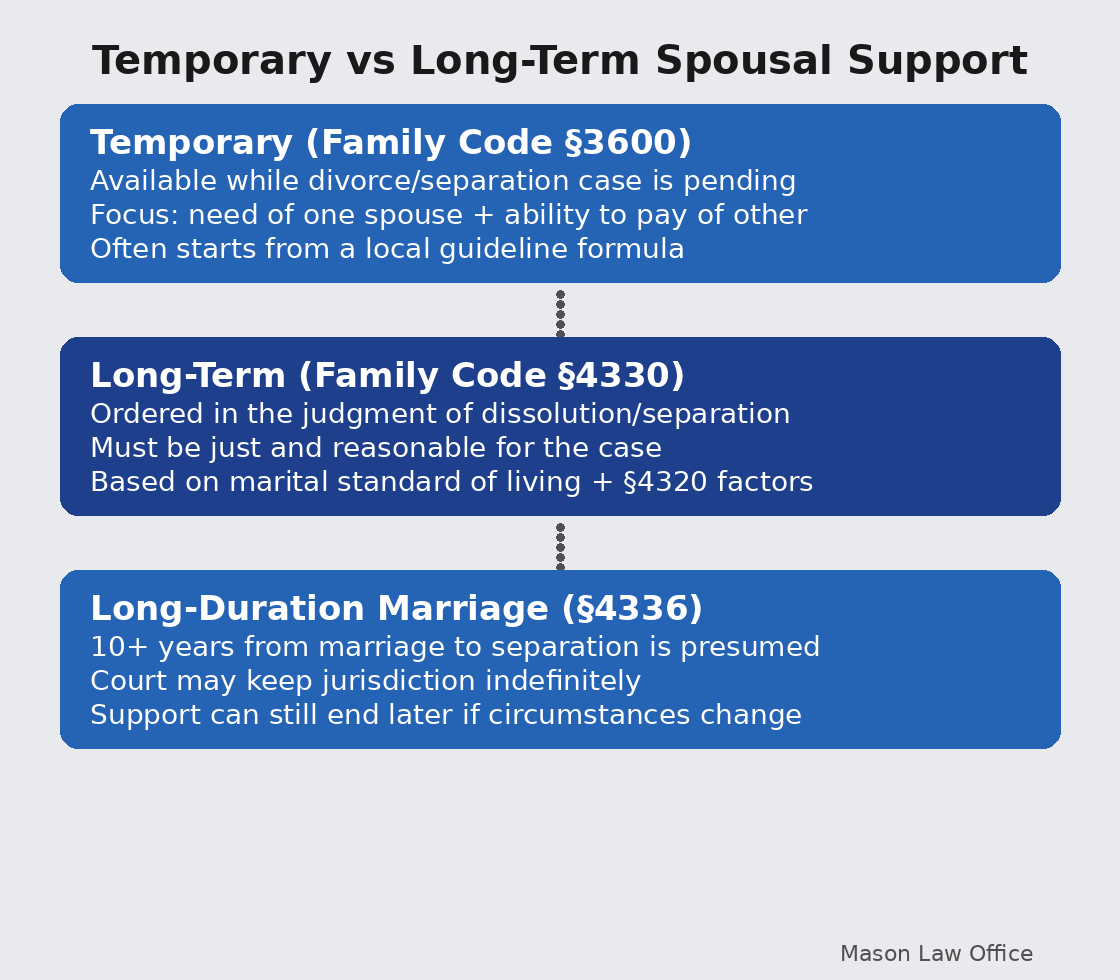
Family Code section 3600 is the key temporary-support statute. During the pendency of a dissolution, legal separation, custody proceeding, or certain child-support proceedings, the court may order either spouse to pay any amount necessary for the support of the other spouse, consistent with subdivisions (i) and (m) of section 4320 and section 4325. Those cross-references mean domestic-violence findings and related conviction rules can already matter at the temporary stage. That temporary authority is designed to stabilize finances while the case moves toward judgment, not to lock in a lifetime award.
Temporary Support Focuses on Need and Ability to Pay
California Courts Self-Help guidance states that judges decide temporary spousal support by looking at the needs of the spouse with less money and the ability to pay of the spouse with more money. Many local courts use a guideline formula as a starting point for that temporary calculation, but the court can adjust based on the facts of the case. Temporary support is meant to keep both households functioning while disclosures, parenting schedules, and property issues are still being worked out.
Long-Term Support Is Ordered in the Judgment
Family Code section 4330 says that in a judgment of dissolution or legal separation, the court may order a party to pay support for the other party in an amount and for a period of time that the court determines is just and reasonable, based on the standard of living established during the marriage and the circumstances in section 4320. When making that order, the court may also advise the recipient to make reasonable efforts to assist in providing for their own support needs, unless the marriage is of long duration under section 4336 and the court finds that warning inadvisable.
Long-Duration Marriages Affect Ongoing Court Jurisdiction
Family Code section 4336 creates an important jurisdiction rule. Except on written agreement of the parties to the contrary or a court order terminating spousal support, the court retains jurisdiction indefinitely where the marriage is of long duration. For that purpose, there is a presumption that a marriage of 10 years or more, measured from the date of marriage to the date of separation, is a marriage of long duration. The court may still find that a shorter marriage is of long duration, and nothing in the section strips the court of discretion to terminate support later on a showing of changed circumstances.
How Courts Actually Weigh Family Code Section 4320
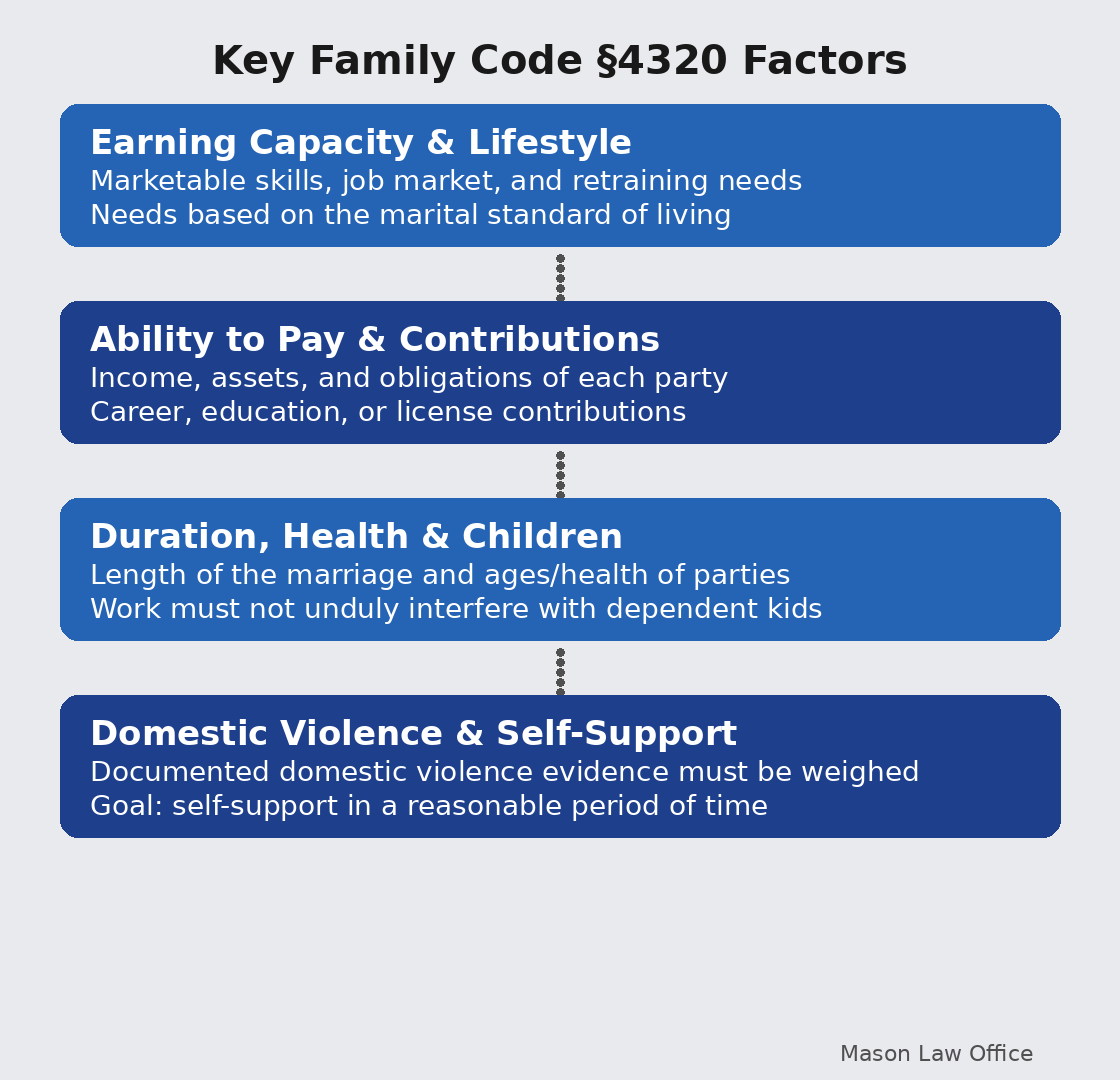
Long-term support is not a rubber-stamp of whatever temporary number was used earlier. Section 4320 requires the court to consider a full list of circumstances, and no single factor automatically controls the outcome. Understanding those factors helps you gather the right evidence whether you are seeking support, defending against a request, or negotiating a marital settlement agreement in Sacramento County, Placer County, or El Dorado County. Judges in these counties apply the same statewide Family Code framework, but the quality of your financial picture and testimony still shapes how the factors land.
Earning Capacity and the Marital Standard of Living
Section 4320(a) directs the court to examine the extent to which each party’s earning capacity is sufficient to maintain the standard of living established during the marriage. That includes the supported party’s marketable skills, the job market for those skills, the time and expense needed for education or retraining, and whether earning capacity was impaired by periods of unemployment devoted to domestic duties. Subsection (d) separately requires the court to consider each party’s needs based on that same marital standard of living.
Ability to Pay, Assets, Obligations, and Career Contributions
Subsection (c) requires consideration of the supporting party’s ability to pay, including earning capacity, earned and unearned income, assets, and standard of living. Subsection (e) covers each party’s obligations and assets, including separate property. Subsection (b) looks at whether the supported party contributed to the other party’s education, training, career position, or license—an issue that often arises when one spouse worked while the other finished professional school.
Duration, Children, Health, Domestic Violence, and Self-Support
The court must also weigh the duration of the marriage, the ability of the supported party to work without unduly interfering with dependent children’s interests, and the age and health of the parties. Tax consequences and the balance of hardships are part of the statutory list as well. Documented evidence of domestic violence, as defined in Family Code section 6211, is expressly part of the analysis under subsection (i), and criminal convictions of an abusive spouse can affect awards under subsection (m) and related statutes. Subsection (l) states the goal that the supported party become self-supporting within a reasonable period of time; except in long-duration marriages described in section 4336, a reasonable period generally is one-half the length of the marriage, though the court retains discretion to order a greater or lesser length based on the other factors. Subsection (n) also lets the court consider any other factors it finds just and equitable.
What Commonly Derails Spousal Support Requests or Defenses
Even when the Family Code framework is clear, practical mistakes can leave a Sacramento County, Placer County, or El Dorado County spouse with a weaker temporary request or a judgment order that does not reflect the real marital standard of living. Courts decide these issues on evidence, not on assumptions about what “feels fair.” The same pattern appears whether the hearing is in Sacramento Superior Court, Placer County Superior Court, or El Dorado County Superior Court: incomplete proof rarely gets rewritten by argument alone.
Treating Temporary Guideline Numbers as the Final Answer
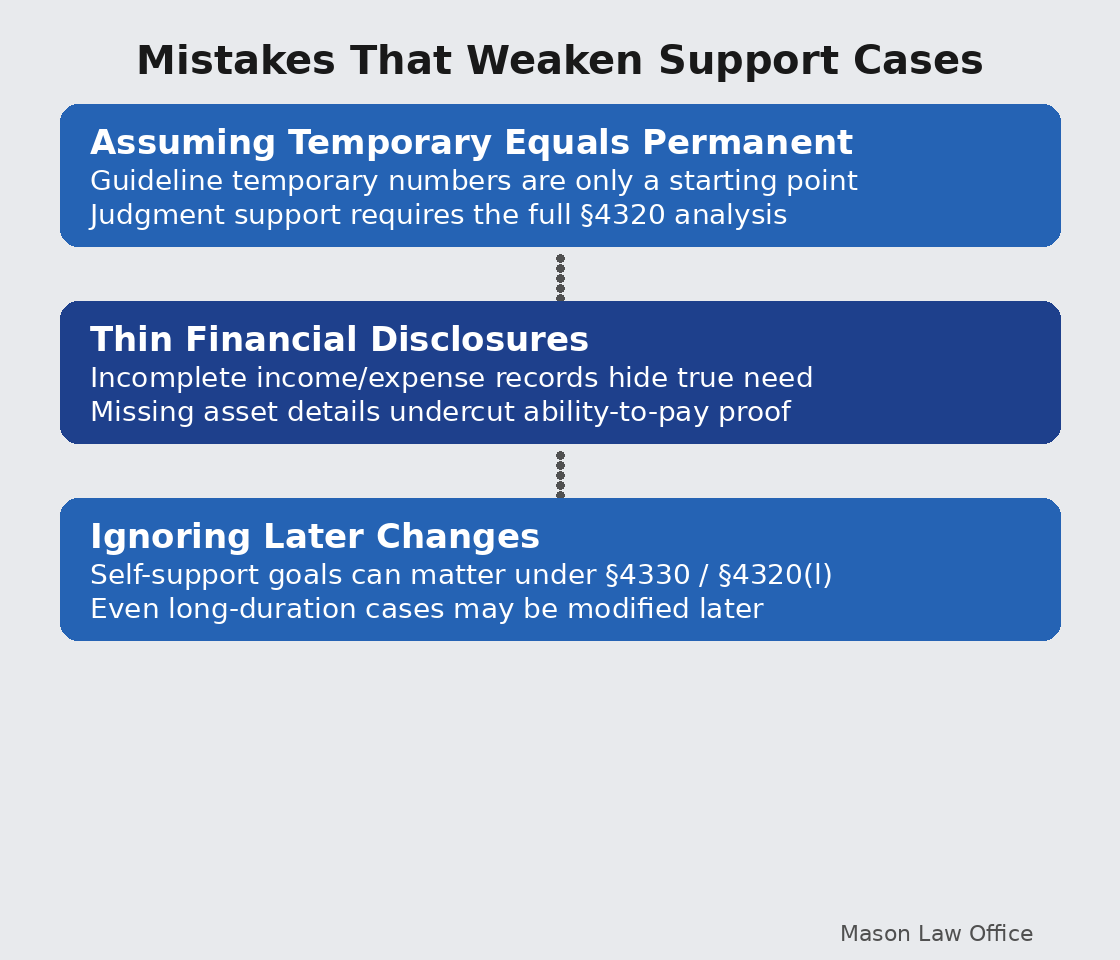
A temporary guideline figure can be useful early in a case, but section 4330 and section 4320 require a different, factor-based judgment analysis for long-term support. Spouses who assume the temporary number will simply continue often fail to develop evidence on earning capacity, marital lifestyle, health, or domestic-violence history that the court must consider at judgment.
Incomplete Income and Expense Disclosures
Temporary support turns heavily on need and ability to pay, and long-term support depends on a detailed picture of income, assets, and obligations. Incomplete or outdated income and expense declarations, missing pay records, or unexplained transfers make it harder for the court to apply section 3600 or section 4320 accurately. Clean disclosures protect both the requesting spouse and the paying spouse.
Ignoring Self-Support Goals or Changed Circumstances Later
Section 4330 allows the court to admonish a supported spouse to make reasonable efforts toward self-support in appropriate cases, and section 4320(l) builds that goal into the statutory factors. Separately, section 4336 confirms that even when jurisdiction continues in a long-duration marriage, the court may still terminate support later if circumstances change. Parties who never revisit employability, remarriage, cohabitation, or major income shifts can be caught off guard when a modification request is filed.
Final Thoughts
Spousal support in Sacramento County, Placer County, and El Dorado County sits at the intersection of temporary cash-flow needs and a carefully structured Family Code analysis at judgment. Temporary orders under section 3600 focus on need and ability to pay while the case is pending. Long-term orders under sections 4330 and 4320 require the court to weigh earning capacity, marital standard of living, duration, health, domestic violence evidence, and the path toward self-support, with special jurisdiction rules for long-duration marriages under section 4336.
If you are separating or already in a divorce or legal separation case and need clarity on temporary or long-term support, contact Mason Law Office to speak with our team serving Sacramento County, Placer County, and El Dorado County. We will review your disclosures, explain how California’s support statutes apply to your situation, and help you prepare a practical next step.